Impulse Response
So far circuits have been driven by a DC source, an AC source and an exponential source. If we can find the current of a circuit generated by a Dirac delta function or impulse voltage source δ, then the convolution integral can be used to find the current to any given voltage source!
Example Impulse Response
The current is found by taking the derivative of the current found due to a DC voltage source! Say the goal is to find the δ current of a series LR circuit .. so that in the future the convolution integral can be used to find the current given any arbitrary source.

Choose a DC source of 1 volt (the real Vs then can scale off this).

The particular homogeneous solution (steady state) is 0. The homogeneous solution to the non-homogeneous equation has the form:

Assume the current initially in the inductor is zero. The initial voltage is going to be 1 and is going to be across the inductor (since no current is flowing):
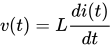


If the current in the inductor is initially zero, then:

Which implies that:

So the response to a DC voltage source turning on at t=0 to one volt (called the unit response μ) is:

Taking the derivative of this, get the impulse (δ) current is:
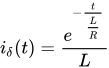
Now the current due to any arbitrary VS(t) can be found using the convolution integral:

Don't think iδ as current. It is really 
LRC Example

Find the time domain expression for io given that Is = cos(t + π/2)μ(t) amp.
Earlier the step response for this problem was found:

The impulse response is going to be the derivative of this:






The Mupad code to solve the integral (substituting x for τ) is:
f := exp(-(t-x)) *sin(t-x) *(1 + cos(x));
S := int(f,x = 0..t)
Finding the integration constant

This implies:

TO DO


This was created with matlab, turned into a gif with ImageMagick, cropped with a photo editor and then released into the public domain.
Several others have created an alternative animation.
- The blue symbol
represents
.
- The red symbol
represents the arbitrary
.
- The current due to the VS black (on top of the yellow).
- The turn on event occurs at t = 5 seconds, not 0.
- The voltage of the source is not on indefinitely. It turns on at zero and off at 5 time constants.
This article uses material from the Wikipedia article
Metasyntactic variable, which is released under the
Creative Commons
Attribution-ShareAlike 3.0 Unported License.