Circuit Theory/Convolution Integral/Examples/2R1LExample/2 Resistor, 1 inductor example

 Find drop across CR1 pair given that Vs 2e2t/to.

Given Vs = 2e2t/to find the drop across the C R1 parallel combination

Outline of solution:

Transfer FunctionEdit

{\displaystyle H(s)={\frac {V_{RC}}{V_{s}}}={\frac {\frac {1}{{\frac {1}{R_{1}}}+Cs}}{R_{2}+{\frac {1}{{\frac {1}{R_{1}}}+Cs}}}}={\frac {R_{1}}{R_{1}+R_{2}+sCR_{1}R_{2}}}={\frac {\frac {R_{1}}{R_{1}+R_{2}}}{1+{\frac {sCR_{1}R_{2}}{R_{1}+R_{2}}}}}}

-- or --

{\displaystyle i_{t}=i_{c}+i_{r}={\frac {V_{s}-V_{RC}}{R_{2}}}=C{dV_{RC} \over dt}+{\frac {V_{RC}}{R_{1}}}}
{\displaystyle {\frac {\mathbb {V} _{s}-\mathbb {V} _{RC}}{R_{2}}}=sC\mathbb {V} _{RC}+{\frac {\mathbb {V} _{RC}}{R_{1}}}}
{\displaystyle \mathbb {V} _{s}=\mathbb {V} _{RC}(sCR_{2}+{\frac {R_{2}}{R_{1}}}+1)}
{\displaystyle {\frac {\mathbb {V} _{RC}}{\mathbb {V} _{s}}}={\frac {1}{sCR_{2}+{\frac {R_{2}}{R_{1}}}+1}}={\frac {R_{1}}{R_{1}+R_{2}+sCR_{1}R_{2}}}={\frac {\frac {R_{1}}{R_{1}+R_{2}}}{1+{\frac {sCR_{1}R_{2}}{R_{1}+R_{2}}}}}}

Homogeneous SolutionEdit

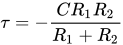
First order so τ is:

{\displaystyle \tau =-{\frac {CR_{1}R_{2}}{R_{1}+R_{2}}}}
{\displaystyle V_{RC_{h}}(t)=A*e^{\frac {t}{\tau }}+C_{1}}

Particular SolutionEdit

After a long time, due to Vs = 1, the capacitor opens. So VRC is part of a voltage divider consisting of just two resistors:

{\displaystyle V_{RC_{p}}={\frac {V_{s}R_{1}}{R_{1}+R_{2}}}={\frac {R_{1}}{R_{1}+R_{2}}}}

Evaluate Initial ConditionsEdit

Combining the homogeneous and particular:

{\displaystyle V_{RC}(t)={\frac {R_{1}}{R_{1}+R_{2}}}+A*e^{\frac {t}{\tau }}+C_{1}}

At t=0, the voltage across the capacitor is zero so:

{\displaystyle V_{RC}(t)={\frac {R_{1}}{R_{1}+R_{2}}}+A+C_{1}=0}

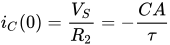
Initially the cap is a short, so the current through the cap is limited by R2 so:

{\displaystyle i_{C}(t)=C{dV_{RC} \over dt}=-{\frac {CA}{\tau }}e^{\frac {t}{\tau }}}
{\displaystyle i_{C}(0)={\frac {V_{S}}{R_{2}}}=-{\frac {CA}{\tau }}}

Since Vs = 1 (doing this for the unit step function because using convolution integral):

{\displaystyle A=-{\frac {\tau }{CR_{2}}}} and {\displaystyle C_{1}={\frac {\tau }{CR_{2}}}}

In summary:

{\displaystyle V_{RC}(t)\mu (t)={\frac {\tau }{CR_{2}}}(1-e^{\frac {t}{\tau }})}

Find impulse solutionEdit

The impulse solution is the derivative of the above:
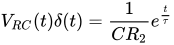
{\displaystyle V_{RC}(t)\delta (t)={\frac {1}{CR_{2}}}e^{\frac {t}{\tau }}}

Convolution IntegralEdit

{\displaystyle V_{RC}(t)=\int _{0}^{t}{\frac {e^{\frac {t-x}{\tau }}}{CR_{2}}}2e^{\frac {2t}{t_{o}}}dx={\frac {2\tau t_{o}}{CR_{2}(2\tau -t_{o})}}(e^{\frac {2t}{t_{o}}}-e^{\frac {t}{\tau }})+C_{1}}
f := (exp((t-y)/x)/(C*R2))*2*exp(2*y/z);
S :=int(f,y=0..t)

Evaluate Integration ConstantEdit

Know that VRC=0 at t=0 so:

{\displaystyle 0=X(1-1)+C_{1}}

So:

{\displaystyle C_{1}=0}

And finally:

{\displaystyle V_{RC}(t)={\frac {2\tau t_{o}}{CR_{2}(2\tau -t_{o})}}(e^{\frac {2t}{t_{o}}}-e^{\frac {t}{\tau }})}


This article uses material from the Wikipedia article
 Metasyntactic variable, which is released under the 
Creative Commons
Attribution-ShareAlike 3.0 Unported License
.