Circuit Theory/Convolution Integral/Examples/Example42

 Given that Vs = (1 + 2t)μ(t), find io using the convolution integral.

example 2nd order circuit with two inductors and two resistors .. solved using the convolution integral in wikibook circuit analysis

Transfer functionEdit

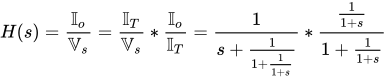
{\displaystyle H(s)={\frac {\mathbb {I} _{o}}{\mathbb {V} _{s}}}={\frac {\mathbb {I} _{T}}{\mathbb {V} _{s}}}*{\frac {\mathbb {I} _{o}}{\mathbb {I} _{T}}}={\frac {1}{s+{\frac {1}{1+{\frac {1}{1+s}}}}}}*{\frac {\frac {1}{1+s}}{1+{\frac {1}{1+s}}}}}
simplify((1/(1+s))/((s+1/(1+1/(1+s)))*(1 + 1/(1 + s))))
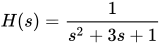
{\displaystyle H(s)={\frac {1}{s^{2}+3s+1}}}
solve(s^2 + 3*s + 1,s)

Homogeneous SolutionEdit

Two real, different roots:

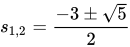
{\displaystyle s_{1,2}={\frac {-3\pm {\sqrt {5}}}{2}}}

So Io has this form:

{\displaystyle i_{o}(t)=Ae^{s_{1}t}+Be^{s_{2}t}}

Particular SolutionEdit

After a very long time, inductors are shorts, the voltage across both 1 ohm resistors is 1 volt, so io is 1 amp:

{\displaystyle i_{o_{p}}(t)=1}

Initial ConditionsEdit

Adding the particular and homogeneous solutions together, have this form:

{\displaystyle i_{o}(t)=1+Ae^{s_{1}t}+Be^{s_{2}t}+C_{1}}

After a long period of time (using the particular initial condition again), the current is going to be 1:

{\displaystyle i_{o}(\infty )=1+C_{1}=1}
{\displaystyle C_{1}=0}

Initially, the two inductors are going to be opens, thus io has to be 0:

{\displaystyle i_{o}(0)=0=1+A+B}

Initially, all the drop is going to be across the first inductor, leaving the voltage across the second zero. The current io flows through both the second inductor and it's serial resistor, so an equation for this voltage can be obtained by taking the derivative:


{\displaystyle V_{L}(t)=L{di_{o}(t) \over dt}=s_{1}Ae^{s_{1}t}+s_{2}Be^{s_{2}t}}
{\displaystyle V_{L}(0)=0=s_{1}A+s_{2}B}
solve([1+A+B,s1*A + s2*B],[A,B])
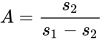
{\displaystyle A={\frac {s_{2}}{s_{1}-s_{2}}}}
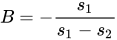
{\displaystyle B=-{\frac {s_{1}}{s_{1}-s_{2}}}}

So:

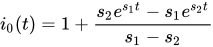
{\displaystyle i_{0}(t)=1+{\frac {s_{2}e^{s_{1}t}-s_{1}e^{s_{2}t}}{s_{1}-s_{2}}}}

Impulse SolutionEdit

Taking the derivative of the above get:

{\displaystyle i_{o_{\delta }}(t)={\frac {s_{1}s_{2}}{s_{1}-s_{2}}}(e^{s_{1}t}-e^{s_{2}t})}


Convolution IntegralEdit

{\displaystyle i_{o}(t)=\int _{0}^{t}{\frac {s_{1}s_{2}}{s_{1}-s_{2}}}(e^{s_{1}t}-e^{s_{2}t})*(1+2x)dx}
syms t x
s1 = (-3 + sqrt(5))/2;
s2 = (-3 - sqrt(5))/2;
f = (s1*s2/(s1-s2)*(exp(s1*(t-x))-exp(s2*(t-x)))*(1+2*x));
S =int(f,0,t);
vpa(S, 3)

{\displaystyle i_{o}(t)=2t+4.96e^{-0.382t}+0.0403e^{-2.62t}-5+C_{1}}

At t=0:

{\displaystyle i_{o}(0)=0=4.96+.04-5+C_{1}}

Which means that C_1 = 0 so finally:

{\displaystyle i_{o}(t)=2t+4.96e^{-0.382t}+0.0403e^{-2.62t}-5}


 article uses material from the Wikipedia article
 Metasyntactic variable, which is released under the 
Creative Commons
Attribution-ShareAlike 3.0 Unported License
.