The Extra Element technique helps break down one complicated problem into several simpler ones like superposition. However the goal is to find impedance rather than current or voltage.
By removing the element that most complicates the circuit the overall circuit impedance can be obtained.
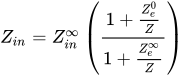
where
- is the impedance chosen as the extra element to be removed

- is the input impedance with Z removed (or made infinite)

- is the impedance seen by the extra element Z with the source shorted (or made zero)

- is the impedance seen by the extra element Z with the source opened (or made infinite)

Computing these three terms may seem like extra effort, but they are often easier to compute than the overall input impedance.
ExampleEdit


Consider the problem of finding 

Removing this capacitor from the circuit we find


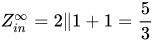
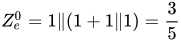
Calculating the impedance seen by the capacitor with the input shorted we find


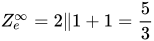
Calculating the impedance seen by the capacitor with the input open we find
Therefore using the EET, we find
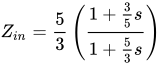
Note that this problem was solved by calculating three simple driving point impedances by inspection.
| This article uses material from the Wikipedia article Metasyntactic variable, which is released under the Creative Commons Attribution-ShareAlike 3.0 Unported License. |