Circuit Theory/Series Resistance


Series ResistanceEdit

Two or more resistor can be connected in series to increase the total resistance . The Total Resistance is equal to the sum of all the resistor's resistance . The total resistance In Series connected circuit Current and voltage will be reduced


Resistors in Series.svg
{\displaystyle R_{tot}=R_{1}+R_{2}+R_{3}+...+R_{n}\,}

Series ImpedanceEdit

used to show how impedance add's in series

A branch is defined as any group of resistors, capacitors and inductors that can be circled with only two wires crossing the circle boundary.

A branch connects two, non-trivial nodes or junctions.

Within a branch the components are said to be "in series."

Consider a branch containing a Resistor, Capacitor and Inductor.

Say the driving function or source is

{\displaystyle V_{s}=10*cos(22400t+30^{\circ })}
{\displaystyle V_{s}=10*e^{-5000t}cos(22400t+30^{\circ })}

There is just one current, I.

Symbolic DerivationEdit

the impedance symbol is .. a box

The terminal equations are:

{\displaystyle \mathbb {V} _{r}=\mathbb {I} *R}
{\displaystyle \mathbb {V} _{L}=\mathbb {I} *j\omega L} or {\displaystyle \mathbb {V} _{L}=\mathbb {I} *sL}
{\displaystyle \mathbb {I} =\mathbb {V} _{c}*j\omega C} or {\displaystyle \mathbb {I} =\mathbb {V} _{c}*sC}

There are no junction equations and the loop equation is:

{\displaystyle \mathbb {V} _{r}+\mathbb {V} _{L}+\mathbb {V} _{c}-\mathbb {V} _{s}=0}

Solving the terminal equations for voltage, substituting and then dividing by \mathbb{I} yields:

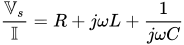
{\displaystyle {\frac {\mathbb {V} _{s}}{\mathbb {I} }}=R+j\omega L+{\frac {1}{j\omega C}}}
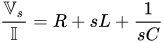
{\displaystyle {\frac {\mathbb {V} _{s}}{\mathbb {I} }}=R+sL+{\frac {1}{sC}}}

In terms of impedance, if:

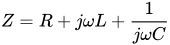
{\displaystyle Z=R+j\omega L+{\frac {1}{j\omega C}}}
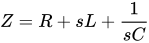
{\displaystyle Z=R+sL+{\frac {1}{sC}}}

Then:

{\displaystyle {\frac {\mathbb {V} _{s}}{\mathbb {I} }}=Z}

In general, impedances add in series like resistors do in the time domain:

{\displaystyle Z=\sum R_{i}+\sum j\omega L_{i}+\sum {\frac {1}{j\omega C_{i}}}}
{\displaystyle Z=\sum R_{i}+\sum sL_{i}+\sum {\frac {1}{sC_{i}}}}
matlab screen shot of numeric calculation .. m-file

Numeric ExampleEdit

In rectangular form:

{\displaystyle Z=100+.15714j}
{\displaystyle Z=80.508+2.2759j}

In polar form (remember impedance is not a phasor, it is a concept in the phasor or complex frequency domain):


{\displaystyle Z=100.0001\angle 0.0016(0.09^{\circ })}
{\displaystyle Z=80.5402\angle 0.0283(1.6193^{\circ })}

This article uses material from the Wikipedia article
 Metasyntactic variable, which is released under the 
Creative Commons
Attribution-ShareAlike 3.0 Unported License
.