Find io(t) if Vs(t) = 1 + cos(3t).

Choose Starting Point
Because of the initial conditions, going to start with Vc(t) and then work our way through the initial conditions to io.
Transfer Function
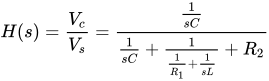
The MuPad commands are going to be:
L :=1; R1:=.5; R2:=1.5; C:=.5;
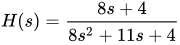
simplify((1/(s*C))/(1/(s*C) + 1/(1/R1 + 1/(s*L)) + R2))
Which results in:
Homogeneous Solution
Set the denominator of the transfer function to 0 and solve for s:
solve(8*s^2 + 11*s + 4)
Imaginary roots:
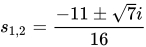
So the solution has the form:

Particular Solution
After a very long time the capacitor opens, no current flows, so all the source drop is across the capacitor. The source is a unit step function thus:

Initial Conditions

Adding the particular and homogenous solutions, get:

Doing the final condition again, get:

Which implies that C is zero.
From the given initial conditions, know that Vc(0+) = 0.5 so can find A:

Finding B is more difficult. From capacitor terminal relation:
VC := 1 + exp(-11*t/16)*(-.5*cos(7*t/16) + B*sin(7*t/16))
IT := diff(VC,t)
The total current is:

The loop equation can be solved for the voltage across the LR parallel combination:


VLR := 1 - VC - 1.5*IT
We know from the inductor terminal relation that:
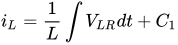
IL := 1/.5 * int(VLR,t)
At this point mupad gave up and went numeric. In any case, it is clear from t = ∞ where the inductor current has to be zero that the integration constant is zero. This enables us to compute B from the inductor initial condition.
t :=0
Set the time to zero, set IL equal to the initial condition of .2 amps and solve for B:
solve(IL=0.2, B)
And get that B is -0.2008928571 ...

The desired answer is io which is just VLR/R_1. To calculate need to start new mupad session because t is zero now. Start with:
B := -0.2008928571;
R1 :=0.5;
Repeat the above commands up to VLR and then add:
io = VLR/R1
