Circuit Theory/Transients Summary and Study guide


RC or LC CircuitsEdit

General solution steps for RL and LC circuits with a voltage source (with out voltage source Vc=0):

  1. Use KVL and KCL, get 1st order differential equation
  2. Find particular solution (Forcing Function) {\displaystyle Y_{p}} (Table is at bottom of page)
  3. The complete solution is the particular + the complementary.
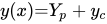
{\displaystyle y(x){=}Y_{p}+y_{c}}

{\displaystyle y_{c}(x){=}K_{1}+K_{2}e^{sx}}

  1. Substitute solution into differential equation to find K_1 and s. (Or find K_1 by solving in steady state.)
  2. Use the given initial conditions to find {\displaystyle K_{2}}
  3. Write final solution

RLC CircuitsEdit

  • DC circuits -> constant forcing functions
  • AC circuits -> sinusoidal forcing functions
  • Particular solution for VDc =>L-> SC, C-> OC
ConceptFormulanotes
Damping Coefficiant (series LC){\displaystyle \alpha {=}{R \over 2L}}
Damping Coefficiant (parallel LC){\displaystyle \alpha {=}{1 \over 2RC}}
Undamped resonant frequency{\displaystyle \omega _{0}{=}{1 \over {\sqrt {LC}}}}
General Form{\displaystyle f(t){=}{d^{2}i(t) \over dt^{2}}+2\alpha {di(t) \over dt}+\omega _{0}^{2}i(t)}
Characteristic equation{\displaystyle s^{2}+2\alpha s+\omega _{0}^{2}{=}0}
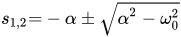
Roots Characteristic eqn{\displaystyle s_{1,2}{=}-\alpha \pm {\sqrt {\alpha ^{2}-\omega _{0}^{2}}}}
Damping ratio{\displaystyle \zeta {=}{\alpha  \over \omega _{0}}}
Overdamped{\displaystyle x_{c}(t){=}K_{1}e^{s_{1}t}+K_{2}e^{s_{2}t}}roots real and distinct
{\displaystyle \zeta >1}
{\displaystyle \alpha >\omega }
Critically damped{\displaystyle x_{c}(t){=}K_{1}e^{s_{1}t}+K_{2}te^{s_{1}t}}roots real and equal
{\displaystyle \zeta {=}1}
{\displaystyle \alpha {=}\omega }
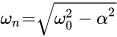
Natural Frequency{\displaystyle \omega _{n}{=}{\sqrt {\omega _{0}^{2}-\alpha ^{2}}}}
Underdamped{\displaystyle x_{c}(t){=}K_{1}e^{-\alpha t}\cos {\omega _{n}t}+K_{2}e^{-\alpha t}\sin {\omega _{n}t}}roots complex
{\displaystyle \zeta <1}
{\displaystyle \alpha <\omega }

Table of Forcing functionsEdit

ValueApproximation
Cons.A
{\displaystyle e^{t}}{\displaystyle Ke^{st}}
sin(t)/cos(t){\displaystyle A\sin(pt)+B\cos(pt)}
{\displaystyle t^{n}}{\displaystyle At^{n}+Bt^{n-1}+...+Ct+D}
{\displaystyle t^{n}e^{t}}{\displaystyle At^{n}e^{pt}+Bt^{n-1}e^{pt}+...Ce^{pt}}